How is presbyopia surgery different from cataract surgery?

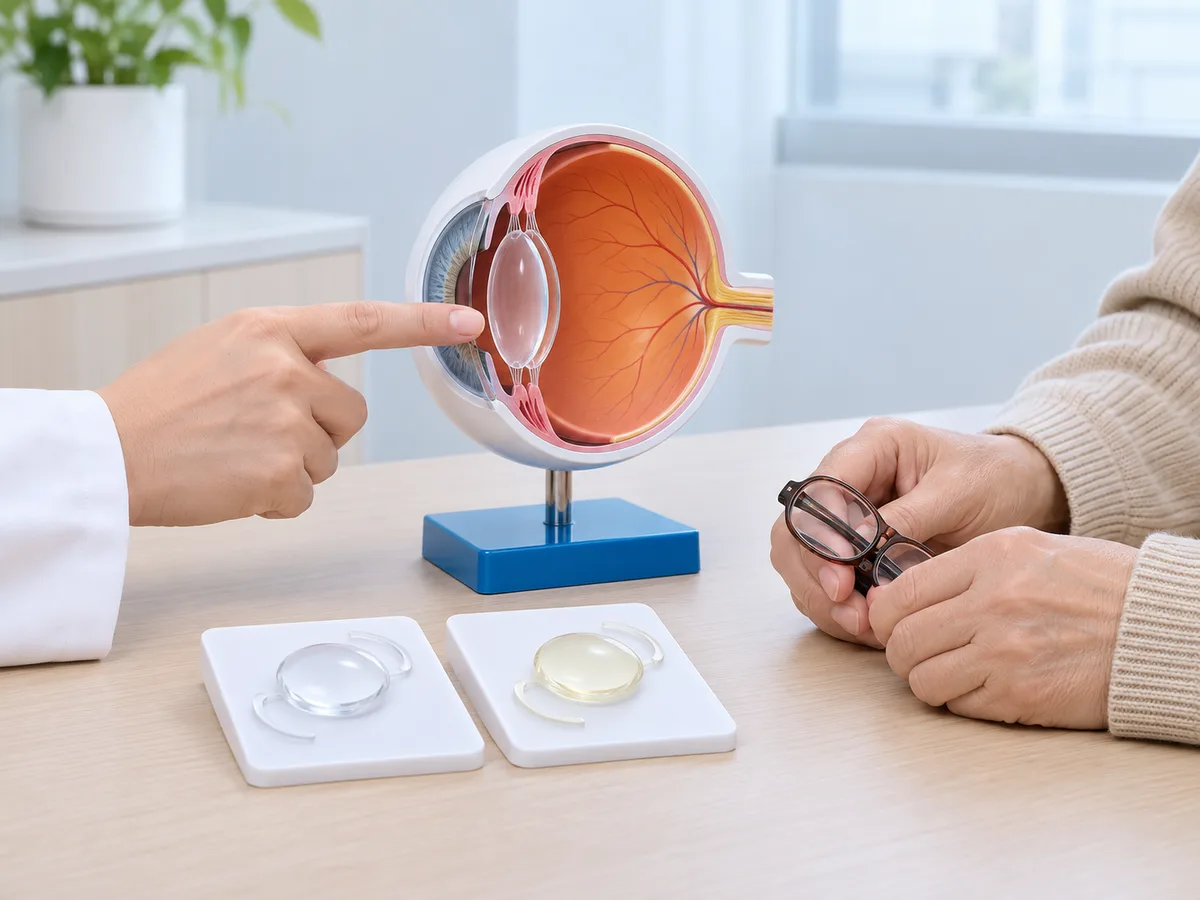
Once you have started using reading glasses and then hear the word cataract, more questions follow. It is easy to be unsure whether cataract surgery also takes care of presbyopia, or whether presbyopia surgery is something done separately.
Below, we go through where the two surgeries are the same, where they part ways, and what to weigh when choosing an intraocular lens. What it is like to first notice presbyopia is covered in The newspaper looks farther away. Are reading glasses all I need?.
Are presbyopia surgery and cataract surgery different operations?
The procedure is the same; the intraocular lens that is placed and the goal differ.
A cataract is a condition in which the lens inside the eye becomes cloudy. A clouded lens cannot be made clear again with medicine or glasses, so it is removed in surgery and a clear intraocular lens is placed in its position. The first goal of this surgery is to remove the cloudiness.
The term presbyopia surgery can refer to several methods, but it usually means placing a presbyopia-correcting intraocular lens during cataract surgery so that you can also see things up close. Other methods that work on the cornea have also been described, but this article explains surgery that replaces the lens.
What changes depending on the intraocular lens?
The distances and the way the lens focuses change, and so do the distances at which you may need glasses and the symptoms that may occur.
A monofocal intraocular lens focuses at one distance. It is usually set for distance, so you may need near glasses to read a book or look at your phone. Another approach sets one eye for distance and the other eye for near.
Presbyopia-correcting intraocular lenses come in several designs. Multifocal lenses split incoming light into several focal points so that you can see far and near, and, depending on the product, at intermediate distance as well. Extended depth of focus lenses do not split light into several focal points; they widen the range over which light is focused, so that vision continues from distance to intermediate range.
| Item | Monofocal intraocular lens | Presbyopia-correcting intraocular lens |
|---|---|---|
| Focus | One distance, usually far | Several distances or a wider range |
| Glasses after surgery | May be needed for near vision | May be needed less, but may still be needed |
| Halos and glare | Relatively less common | May occur more; varies by design |
| Also consider | Whether wearing near glasses bothers you little | Other eye conditions, night-time activity, adaptation |
Neither lens type has been established as better. Studies suggest multifocal lenses help near vision and reduce reliance on glasses, but how much of the trade-off in halos a person can accept differs from person to person.
Can I have surgery for presbyopia without a cataract?
Rushing into surgery for presbyopia alone when the cataract is not significant is not recommended.
The basic correction for presbyopia is glasses made for your eyes. There are several surgical ways to correct presbyopia, but none can yet be called perfect, and surgery carries risks such as infection and retinal detachment. So basic correction such as glasses comes first, and surgery is decided carefully after a thorough discussion.
On the other hand, if a cataract makes everyday activities such as reading, driving or watching TV difficult and you have surgery, a presbyopia-correcting lens can be considered at that point. Cataract surgery itself usually does not need to be rushed, so the timing is set by weighing how much it bothers you against the benefits and risks of surgery.
Surgery to replace an intraocular lens later can become more difficult as time passes. It is best to choose the lens after a full explanation before surgery.
When might multifocal lenses not suit me?
If you have other eye conditions, or if halos around lights at night would seriously affect your daily life and work, another option may be better.
- Retina, macula or optic nerve conditions: With conditions such as macular degeneration or glaucoma, the result of surgery may not be as good as hoped, and it may be hard to gain the benefits of a multifocal lens.
- Astigmatism: Remaining astigmatism or a power error can feel more bothersome with a presbyopia-correcting lens, so a lens that also corrects astigmatism is considered.
- Frequent night driving: First consider how much halos and glare around lights would affect your daily life and work.
- Eyes that have had vision correction surgery: The refractive power of the cornea is hard to measure accurately, so a power error can occur.
- When wearing glasses does not bother you much: How strongly you want to rely less on glasses is an important basis for the choice.
For this reason, the tests before surgery include more checks for other conditions than for the cataract itself. The pupil is widened to examine the retina and optic nerve, and the length of the eye and the shape of the cornea are measured to set the lens power. Correcting astigmatism at the same time is described in CALLISTO astigmatism correction surgery.
What discomfort and risks can follow surgery?
There are the risks that come with any cataract surgery, and presbyopia-correcting lenses can add halos, glare and reduced contrast.
Most people recover well from cataract surgery, and serious complications are rare. Still, as with any operation, the following can happen, and some need further treatment or surgery.
- Problems inside the eye: Inflammation or swelling, bleeding, infection, changes in eye pressure, retinal detachment or a problem with the position of the intraocular lens can occur.
- Later clouding: Weeks to years after surgery, the membrane holding the lens can become cloudy (posterior capsule opacification), and it is treated with a laser.
- Symptoms related to the lens: With multifocal lenses, seeing halos around lights at night or feeling glare is more common than with monofocal lenses, and the ability to distinguish differences in brightness (contrast sensitivity) can be reduced.
- Adaptation and glasses: How quickly people get used to the image a new lens creates varies from person to person. Whatever the lens type, you may need glasses after surgery.
What should I prepare for my visit?
- Records of past eye surgery Tell us if you have had vision correction surgery or any other eye surgery. This is taken into account when calculating the intraocular lens power.
- Medicines you take and conditions you have We check whether you take any medicine that could affect surgery, such as blood thinners.
- Distances you often look at and whether you drive at night Noting which you do most among books, phones, computers and driving, and how much wearing glasses bothers you, helps in choosing the lens.
Presbyopia-correcting intraocular lenses are described in Presbyopia and cataract surgery, and monofocal intraocular lenses in Monofocal cataract surgery. For costs, please check Non-covered fees.