


The newspaper looks farther away. Are reading glasses all I need?

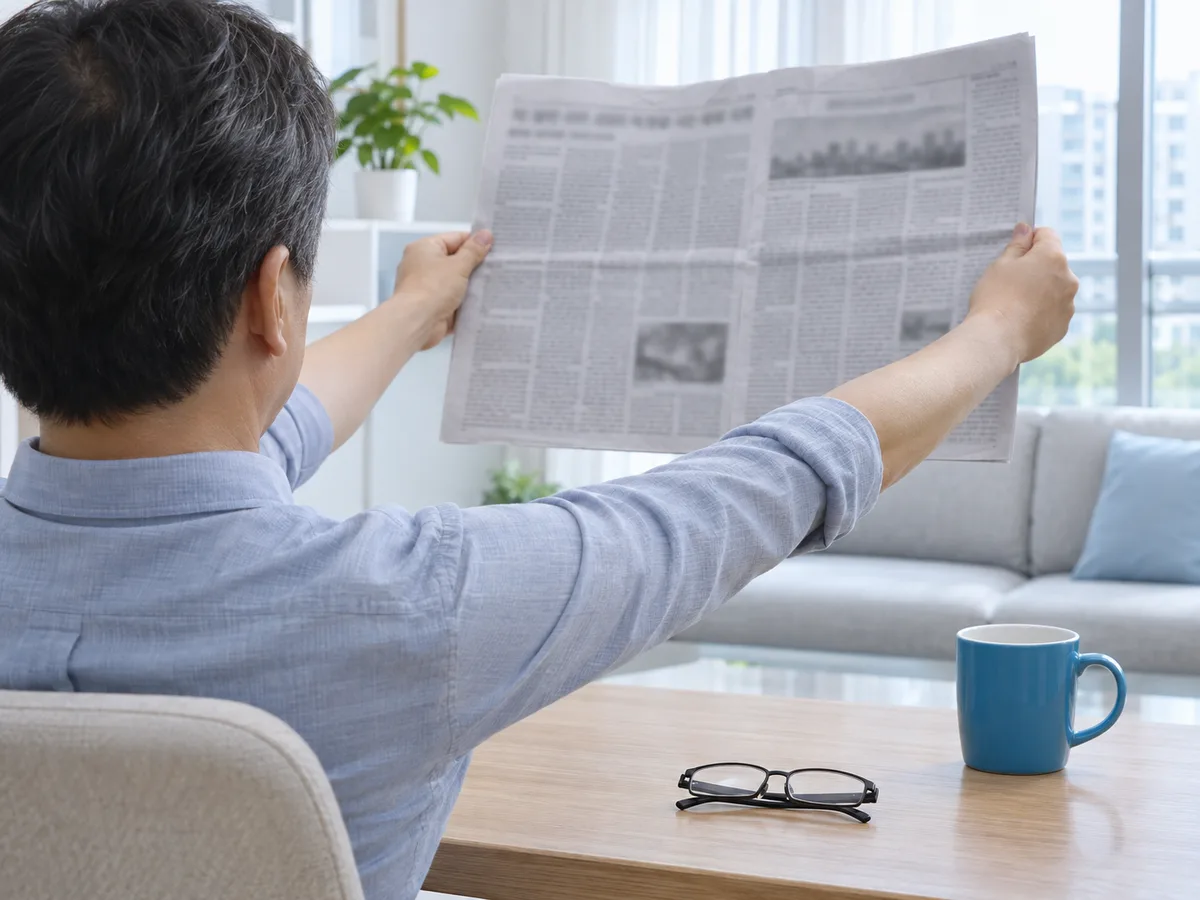
One day you notice you are stretching your arms farther and farther to read the newspaper. You make the text bigger on your phone and move to a brighter spot by the window. Buying a pair of reading glasses at a pharmacy or convenience store may seem like the answer.
Here is what is worth knowing before you choose a pair, step by step.
If I have to hold the newspaper far away, is it presbyopia?
It is likely, but an eye exam is the reliable way to confirm it.
The lens inside your eye changes its thickness to focus on things up close. With age the lens becomes harder and less flexible, so this focusing ability declines. This is presbyopia. It is less a disease than a change that happens to everyone with age, and most people first notice it in their early to mid-40s.
Presbyopia can bring changes like these.
- You hold text farther away: Books and phones look clearer the farther you hold them.
- Focusing takes longer: Switching focus between far and near takes a moment.
- Dim light makes it harder: Text blurs more in dim light or when it is small, and reading for a long time can leave your eyes tired or give you a headache.
Presbyopia is not the only reason near objects look blurry. A refractive error you already had, such as farsightedness, or another eye condition can also be the cause, so vision and refraction tests are used to find out.
Do nearsighted people notice presbyopia later?
They may notice it later, but they still develop presbyopia.
If you are nearsighted, taking off your distance glasses or lowering their power lets you see up close reasonably well, so you may notice presbyopia later. People who are farsighted, on the other hand, tend to notice it earlier. The loss of focusing ability in the lens happens to everyone, whatever their eyes were like before.
That is why people who have worn glasses for nearsightedness may do better with lower-power glasses for near work or multifocal glasses than with ordinary reading glasses.
Are ready-made reading glasses all right?
They are fine as a spare pair, but your main pair is best made after an exam.
Ready-made reading glasses from a pharmacy or convenience store have the same power in both lenses. They can work well if both eyes need the same power and you have no astigmatism. Otherwise, things may not look clear enough. If the frame does not fit your face and you are not looking through the centre of the lenses, your eyes may tire or you may get a headache.
Wearing ready-made glasses will not harm your eyes. You can keep one pair made for your eyes and use ready-made pairs as spares in your bag or living room.
| Item | Ready-made reading glasses | Glasses made after an exam |
|---|---|---|
| Power | Same power in both lenses | The power each eye needs |
| Astigmatism | Not corrected | Can be corrected as well |
| Works well when | Both eyes need the same power and there is no astigmatism | The eyes need different powers or there is astigmatism |
| Use | Spare or extra pair | Your main pair |
The power is not chosen by a number for your age. A refraction test first checks your distance vision, and then the lowest power that lets you see comfortably is chosen, taking into account what you mainly look at and how close, your age, and the length of your arms. If you spend long hours at a computer screen, which sits a little farther away than a book, a separate pair set for that distance may be more comfortable.
Can presbyopia be slowed down?
No method is known so far to prevent or slow presbyopia.
Early on, brighter light, larger text, and holding reading material a little farther away may be enough to get by. When the discomfort grows, wearing glasses that suit your eyes is the basic step.
The reading power you need starts low and slowly increases with age. Presbyopia tends to stop progressing after the late 50s.
Some people who do not want glasses consider presbyopia correction surgery. However, rushing into surgery for presbyopia when a cataract is not advanced can cause side effects, so basic correction such as glasses comes first, and the decision is made after a thorough consultation.
What else should be checked when I get reading glasses?
An eye exam looks for other eye conditions as well as presbyopia.
Many eye conditions have no clear symptoms early on. Once presbyopia starts, it is a good idea to have regular eye exams to check that no other conditions, such as cataract or glaucoma, are present too. Even if you use reading glasses bought without a prescription, keep up with your eye exams.
What should I prepare for my visit?
- The glasses and reading glasses you use now Bringing your distance glasses and any reading glasses you bought lets the doctor compare them with your current power.
- Viewing distance and time Noting how much time you spend each day on books, phones, or computers helps decide the power and the type of glasses.
- When it bothers you Note when things are harder, such as in dim light, when looking at small print, or when looking at something for a long time.
You can learn about care that looks at presbyopia and cataract together on Presbyopia and cataract surgery, and find our hours and location on Hours and directions.